
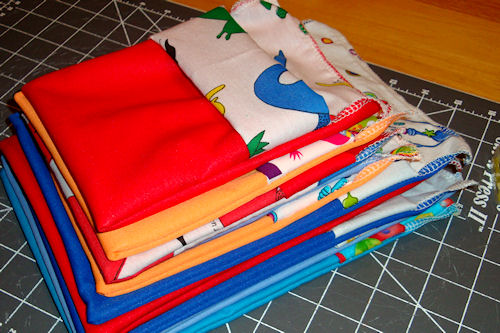
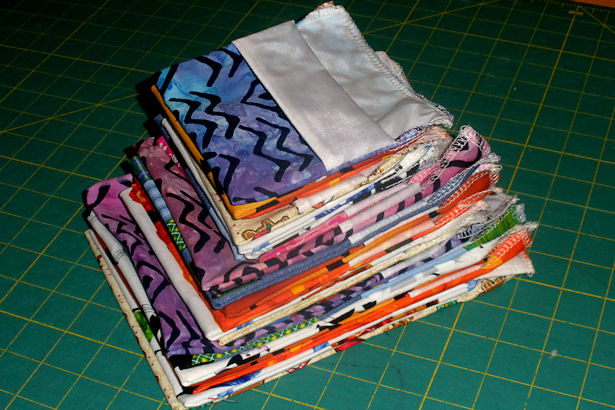
Cloth wipes are versatile, gentle on your child, easy to make, and save you money! They can be used for sticky hands and messy faces as well as dirty bottoms, and can be laundered with your cloth diapers or towels. Wet them with plain water or a homemade wipe solution before use. Two dozen wipes is a good number to start out. It sounds like a lot, but once you get the hang of making them you’ll have a stash of cute wipes in no time!
Making cloth wipes is very easy, even beginning sew-ers can make them! They can be made out of almost any fabric you want, as cheaply or luxuriously as you choose. I started making cloth wipes over 14 years ago after receiving a dozen commercial cloth wipes from a friend when I was expecting our second child. I took one look at them and thought “I can make these”, and I did!
First you need to decide what kind of fabric you want to use. I started out cheaply, by cutting up an old towel. You can also use flannel, terrycloth, velour, and diapering fabrics like sherpa or hemp fleece. For really luscious wipes try organic velour, yum!! Two fabrics that don’t work well are fleece and woven fabrics. Fleece just smears the poo around and wovens are too thin to absorb. If you use a thicker fabric you can make one-layer wipes, but thinner fabrics can be used in two-layer wipes. Two layers are cushier and more absorbant, so that’s what I prefer.
Next you need to decide what size to make your wipes. I like 8×8 or 4×8, but you can make them any size you want. My 4×8 wipes fit in an old commercial wipes container without folding, and the 8×8 wipes fit when folded in half once.
Finally, choose the level of sewing you feel most comfortable with. If you’re a beginner, try Easy first and progress to Tricky.
Easy: One-layer wipes are the easiest to make!
- Cut your fabric into squares or rectangles the size you decided on. You can round the corners by tracing a quarter if you don’t want square corners.
- Zig-zag or serge all the way around the edge, removing the pins as you go. Be sure that the “zag” of the stitch goes a little over the edge to keep the fabric from getting raggedy.
- Be sure to backstitch at the beginning and end of stitching, or finish the serge stitch, so the stitching won’t pull out.
- Trim the threads close to the fabric, and you’re done!
You can use different colors of thread or variegated thread for a more decorative look. When I make wipes for my son I like to use up odd spools of thread that I have leftover from other projects.
Medium: Two-layer zig-zag/serged wipes are a little more difficult, but will get easier with practice.
- Cut both fabrics into squares or rectangles the size you decided on. You can trace quarters to round the corners if you’d like.
- Lay one layer with the “right side” down so you’re looking at the back of the fabric.(The right side is the front of the fabric, the side you want to look at and use.)
- Place the other piece of fabric on top of the first, with the right side up and facing you.
- Check to make sure you can see the right side of both pieces of fabric on the outside.
- Line up the edges of the layers and pin all the way around the wipe.
- Zig-zag or serge all the way around the edge, removing the pins as you go. Be sure that the “zag” of the stitch goes a little over the edge to keep the fabric from getting raggedy.
- Be sure to backstitch at the beginning and end of stitching, or finish the serge stitch, so the stitching won’t pull out.
- Trim the thread close to the fabric and admire your work!
If you want a more decorative look, you can use different colors of thread or variegated thread.
Tricky: Two-layer “T&T” (turned and topstitched) wipes are a little tricky, but with practice you can do it!
- Add 1/4 inch to each side of the wipes when you cut them out. (That means that if you want 8×8″ wipes, cut the fabric 8 1/2 x 8 1/2.)
- Cut both fabrics into squares or rectangles the size you decided on, remembering to add 1/4 inch. Leave the corners square, it’s easier than rounded corners.
- Lay one piece of fabric with the “right side” up and facing you.(The right side is the front of the fabric, the side you want to look at and use)
- Lay the other piece of fabric on top of the first with the right side down.
- Check to make sure that both pieces of fabric have their right sides together on the inside.
- Line up the edges and pin all the way around. Be sure that you can see the WRONG side of the fabric on both sides of the wipe.
- With a straight stitch, stitch almost all the way around the wipe, about 1/4 in from the edge.
- Stop about 2 inches from where you started sewing, backstitch and cut the threads.
- Trim each corner near the stitching so it’s not bulky when you turn it right-side-out.
- Carefully turn the wipe right-side-out through the opening you left.
- Fold the edges of the opening in so they’re inside the wipe and the outer edge is straight.
- Pin the edges of the opening to hold it closed.
- Straight stitch all the way around the wipe less than 1/4 inch from the edge, making sure to close the opening. (If you stitch too far away from the edge you won’t close the opening and those edges will flip out and get raggedy.
- Remember to backstitch when you begin and end stitching.
- Trim the threads and admire your work!
You can also try zig-zag stitch or another decorative stitch instead of straight stitch on the outside of your wipes. Variegated thread doesn’t work well for straight stitch, but using coordinating or contrasting thread colors makes the wipes look nice.
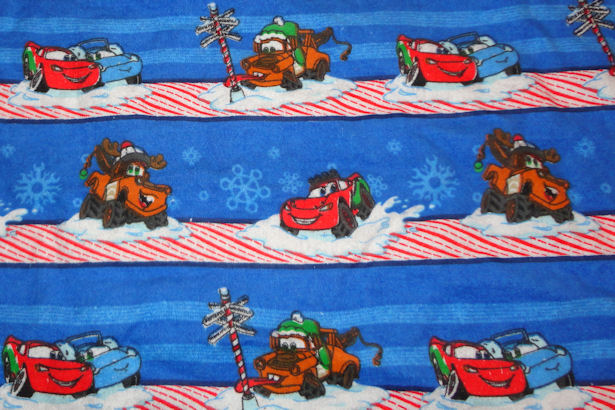
Have fun making lots of wipes for your child! If you make clothing or dipers you can make matching wipes for your child with the fabric scraps.



thanks for the great directions. just might have to search for some organic velour and make some wipes.
Thank you… so many sites have things all over the place, and every time I search it I get something different… but you have everything in one place!
Now if I can only get better with my zig-zag.
All it takes is practice. 😉 I’m glad you find the directions helpful!
~Amy Sue
I’m a sewing flunkee! I tried very hard to make some cloth diapers this week with a sewing machine I got off freecycle and they looked awful. Now granted I’ve never sewn in my life so just threading the machine and sewing at all was a miracle. I think the pattern I was using was just too complicated for me to begin with (4 layer diaper out of a tshirt with 4 layer soaker pad, zigzag and straight stitched, added elasticat the legs and back, then turned right side out and stitched in the front, added velcro for closing since I hate pins.) But they looked horrid so I threw them away. Maybe I’ll try making these simple wipes instead and try diapers a little later.
That pattern does sound complicated for a beginner. The best way to learn how to sew is to start with simple projects that are quickly completed – like cloth wipes or prefold diapers. Then as you get more comfortable with the machine you can try more complicated projects. Instead of throwing away the diapers you made, maybe you can cut them up and make them into cloth wipes. Good luck!
~Amy Sue
Pingback: Tipnut’s Picks: 50 Free Projects For Baby » TipNut.com
Pingback: Learning to Sew? - AmityMama.com
Pingback: This Simple Life » Blog Archive » Say Goodbye to Disposable Wet Wipes
My daughter-in-law sent me to your site. The directions were easy to follow and in three evening I had made three dozen. I used flannel on one side and terry cloth on the other. Some were just flannel and some were just terry cloth. Very easy. Fun to make and gave me a chance to pray for my future grandson while I was working on the project.
thank you for the instructions, I was trying to decided if I needed double layer of my flannel and how I was going to work my edges. I have a serger, just not real comfortable with it, (At least not where you will see my stitches.) so I decided to turn and top stitch. (If I can make diapers, I can do these.) I already preshrunk and cut out my 8 x 8 flannel, but my question is will the fabric shift while in the wash or stay nice and flat?
Thank you, thank you, thank you!!! This is awesome!
That sounds nice!
Where can I find organic velour?
Would flannel & cotton fleece work since you mentioned that while fleece isn’t good hemp fleece is…
Yvonne,
I purchase organic velour through co-ops – search Yahoo groups for “organic velour” and you’ll find some. Be sure to research any group well before placing an order as there are scammers out there.
Honestly, I don’t think it’s necessary to use organic velour for wipes, regular cotton velour like you can find at your local fabric shop is just as nice for wipes. 🙂
Flannel and cotton fleece – like sweatshirts are made of – would be fantastic! I’d put the fuzzy side of the fleece on the outside. Cotton terry is super too – it’s the same as fleece except the loops haven’t been cut and combed.
Have fun making your wipes!
~Amy Sue
Hello Amy,
thanks so much! I am a part of the co-op that and it will be my first time ordering from a co-op. I was referred there from a well-known person who helps people decide what fabrics and how to make cloth diapers.
The co-op is doing bamboo velour, bamboo terry, bamboo fleece & bamboo french terry. The velour and terry does have 2% of poly in it…it also has 70/28 bamboo & organic cotton…
The fleece is 70/30 bamboo/organic cotton.
They are all under $9/yard…
Is this good? Or should it be just cotton velour or cotton fleece?
Thank you for your time! :0)
Yvonne
All of those fabrics will work well for cloth wipes. 🙂 And under $9/yard is a good price for those fabrics, especially the bamboo velour.
Good luck!
~Amy Sue
Tehe, thanks, Amy!!
I so look forward to those fabrics!!
Pingback: The Mom Crowd » Living Without Toilet Paper?!
I make P-dabbers [vaginal pee wipes] with colorful printed cloth on one side and terry cloth [used towels] for the other with a loop to hang.I wash them by hand in a bucket with essential oil and hang them to dry. My grandaughter and friends all made and use their own. If you do some research you’ll find there are serious toxins in toilet paper and we are using up our forests at an alarming rate.
I used to buy wipes then suddenly I figured why buy when I can make my own. Thanks for all the information.
Pingback: what i hope to accomplish this weekend « two smiths and a dog
Hello,
Can I make these without a sewing machine? I don’t really know how to sew, but I bet with a little help, I can do it!
Thanks!
Jessica
Jessica,
You could make them without a sewing machine, but it’d be a lot of hand-sewing which in my opinion isn’t worth it unless you’ve got tons of time on your hands and nothing better to do.
You could do one-layer wipes by just cutting the fabric into squares and not finishing the edges, BUT you have to choose the right kind of fabric. Flannel, terrycloth (like towels) and wovens (like button-down shirts) won’t work because they’ll all fray terribly.
Polyester fleece, microfleece and suedecloth won’t work because they tend to mush the poo around instead of collect it.
The best bet for no-sew wipes would be a knit (like a t-shirt) or cotton fleece (like a sweatshirt). The edges may roll but they won’t totally unravel. Just cut them into squares and you’re ready to go!
~Amy Sue
Pingback: Building Up My Wipes Stash « Curiositys
Thank you I am have just bought a lot of cloth diapers and wanted to make some wipes to. I have tons of extra swaddling blankets 100% cotton and flannel so I am using the stained ones with a zig zag stich. Thanks for the easy instructions GO GREEN 🙂
Christine,
You’re very welcome for the easy instructions! If your blankets are on the thin side I’d make them two-layer wipes, to avoid anything wicking through to your hands. Just my two cents. 😉
~Amy Sue
Pingback: DIY Green Baby Project: Make Your Own Reusable Baby Wipes Kit
I used dishtowels and receiving blankets for double-sided (pre-washed both beforehand). I got 6 wipes to a dishtowel and the thickness is perfect. I also made “potty wipes” just to get the pee off of baby’s skin when she isn’t poopy. I cut squares out of the leftover receiving blankets and zig-zagged around the edges. Working great! 2 dozen double-sided and 2 dozen potty wipes.
Hi Faith,
Those sound like fantastic wipes! You’re right – dishtowels are a perfect thickness for wipes.
Thanks for taking time to comment!
~Amy Sue
Aloha…..Living in Hawaii after a month long trip down the W.Coast. One of my conversation pieces with others are about washable pee wipes. You cannot imagine how many women have reacted negatively to them. They felt it was too unhygienic!! My granddaughter’s mom is a nurse and she won’t let her daughter have them in her bathroom! I was actually thinking of marketing my own version I call “P-Dabbers”….but the response isn’t encouraging. What do we need to see….all our trees gone….or more vaginal diseases due to the toxins in TP and tampons? I remember back in the early 80’s when I made my own menstrual pads….it was the same story. Are we just not ready yet? I LOVE washing them and hanging them up in the sun or over a woodstove. I LOVE that I’m doing MY part to keep paper use at a minimum. I just tidied up a yurt used for a women’s retreat. I was shocked at how much TP they used in one weekend!!!
Good for you Bequin!
It’s hard to change, especially when there’s so much marketing for disposable products implying that they’re the only way to go. We still use TP and tissues here, but otherwise we’ve switched to reusable cloth for everything else. I figure every little bit helps. 🙂
~Amy Sue
So once they’ve been made, how do you care for them?
Good question JB!
We use our wipes with cloth diapers so I just throw them in the diaper pail and wash them with the diapers. Our other reusable cloth items like un-paper towels and cloth napkins are washed with towels. If we didn’t have the cloth diapers to wash I’d toss used wipes in with the towels, but do a cold rinse before washing.
~Amy Sue
We need to free ourselves from those very words “It’s hard to change”. That way of thinking keeps the brakes on. Standing up to our values and passing them on to our children is what creates the change we all want. I know…I know…this is just about paper use. But….paper is from trees….and we are using way more than what can be replenished. We are sending a strong message to the paper manufacturers that we want…and will buy their products!! As for using cloth substitutes …I have several in use so that they can dry out between “dabs”. Then, when you can detect a urine smell….I set it aside until I have several to wash. A small bucket with soap, tea tree oil and hot water does the trick….or you can fling them into a load of laundry [I still use a wringer washer so they really get clean!]. After rinsing with lavender essential oil….I hang to dry…thou using a dryer probably sterilizes them even more.Try it for just a week….and see what arises and get back to me. I’d appreciate feedback!
Great advocacy for cloth Bequin!
And you’re right, it’s about more than just paper vs cloth. There’s a fantastic 20-minute “The Story of Stuff” (Google it) about our consumerism and how it’s affecting our world. She’s written a book about it too, but I haven’t read it yet. Check out the video, I’m sure you’ll like it! (I’m not affiliated, I just think it’s great!)
~Amy Sue
Hi Amy….Yes….someone sent me a link to that film several years ago because I was the only person they knew who was on the journey to be “barcode free”. I loved it! And shared it with many. B
Very cool! I wasn’t aware of it until just a week or so ago.
~Amy Sue
i surged up about 12 recieving blankets into 8×8’s and i keep some damp in a container for wipes. i also add one into the prefold diapers i use to keep my nice white diapers from getting too stained!! i have a ton of them but am using them for one child and due to use them on another in a couple short months! my five year old gets paid 50 cents to fold the clean wipes and diapers so she gets something out of them too!
Elaine,
What a great idea to use receiving blankets! I’ll bet they’re nice and thick – perfect for cloth wipes.
My five year old helps fold too but I don’t pay him, so don’t tell him that you pay yours, LOL!
Thanks for taking time to comment!
~Amy Sue
I am so excited to start trying these directions! Thank you!
Maria,
Glad you like the directions. Be sure to let me know how yours turn out!
~Amy Sue
Pingback: Our cloth diapering game plan
Hmmm, maybe I’ll just buy some disposable wipes instead of doing them. Its more convenient.
Francine,
That is certainly one option. I know many cloth diapering mamas who choose to use disposable wipes instead of cloth wipes. The nice thing about cloth wipes is that once you’ve got them you can use them over and over and over again. I’ve been using some of mine for over 5 years – that’s a lot of savings over disposable wipes!
Everyone needs to decide what works best for them – I’m not going to judge. 🙂
~Amy Sue
Yeah, you have a good point there Amy. You will see the savings and convenience for over some period of time. Since you can re-use the cloth wipes, you certainly save money in the long run.
Fred,
That’s the idea: save money and save the Earth. Just one small step at a time.
Thanks for commenting!
~Amy Sue
I just thought I’d comment so others know how well these wipes work when made. I chose to make the “tricky” wipes, but I went ahead and did a kind of basting stitch for extra reinforcement, and then turned them inside out to finish them with a zig-zag stitch. I did flannel for one side and terrycloth for the other, which makes a very versatile wipe that’s perfect for even the worst messes. I used them for months with my son, and plan to use them with the next baby we’re expecting. I’ve also given them away for baby shower gifts, and everybody has told me they work very well. People use them as wash cloths if they don’t cloth diaper.
I found that in just about a month of use, I got my money back for the investment in cloth wipes. A 6-package box of generic disposable wipes here is about $12, and when babies are young, that lasts a few weeks with all of the frequent diaper changes. I used coupons and was able to get a yard of terrycloth, a yard of flannel, and thread for about $10. So after that first month, I was saving money every time I used the wipes.
They are also very easy to wash since I just threw them in with the cloth diapers. I used white terrycloth, and none of them have stains. Most still look almost new.
Thank you so much for the great instructions!
Courtney,
Thanks so much for your kind comments! I’m glad the instructions were helpful to you. Our wipes have made it through both of my youngest sons and are still going strong with my granddaughter. I can’t begin to figure out how much money we’ve saved.
Thanks for taking time to comment – you made my day!
~Amy Sue
Wow thanks for this helpful guide, I’ll be surely making some of these cloth wipes soon! Thanks for the guide!
Tom,
Thanks for taking time to comment! Let me know how your wipes turn out, and what you use them for.
Have a great day!
~Amy Sue
Thanks for the tips, very useful!
im so glad I found this site! I cant wait to make some! My question is: how many yards of fabric do I need to make 24 wipes? Thanks!
Jessie,
It all depends on how big you make your wipes and how wide the fabric is. I can never remember how wide any fabric is, except I know most wovens are 45″ wide. I usually mark out a 36″ x 24″ rectangle on graph paper then figure out how many wipes I can cut from that amount of fabric; I figure that way I’ll get the minimum I want and if the fabric is wider I’ll get some extras. If you’re good at math you can probably look at the fabric width and do the math in the store but I always mess it up.
Remember you’ll need twice as much fabric if you make double-layered wipes!
Let me know how they turn out – I’d love to see a photo!
~Amy Sue
I was googling on how to make these, as I plan on cloth diapering when my first baby is born this May. It made sense, seemed cheaper, and seemed like it would clean better, so I was looking into it. Your tutorial looks easy to follow and I am going to go out on a flannel finding expedition today at JoAnn’s. I hope it turns out okay with hand-sewing, though, because I have no machine.
I also like how a previous poster mentioned that she uses them for when she pees. I may start doing that. It would be better for the environment, plus I think I am the one that uses a lot of toilet paper that way (my husband shakes and leaves, I think, if he pees).
Anyways, great idea. Thanks.
Rebecca,
Since you don’t have a machine you could always make one-layer wipes. Flannels fray a LOT so you’d need to do a “pinked” edge – it looks like this: /////. You’ll need a “pinking” shears to cut the zigzags, but then you wouldn’t have to sew them because the zigzags will keep the edges from fraying so much.
Or you could get a knit fabric – the edges might curl but they won’t fray, even if you cut them straight instead of pinked.
Let me know what you do, and send a photo!
~Amy Sue
I just bought 24 precut wipes made from cotton sherpa that I plan to do this with. Bought them from wazoodle(dot)com.
Tammy,
Great idea! Let me know how they turn out, I’d love to post a pic.
Thanks for taking time to comment!
~Amy Sue
I just made a bunch of family cloth wipes. I bought a used flat, king size, flannel sheet from the thrift store for 25 cents. Cut out lots of squares 8×8 and serged two together. I am the only brave one using them right now. I’m waiting for the others to get use to the idea. I thought it was a good idea since I use cloth menstrual pads too. I will never go back to disposables. Thanks for the great idea. I think with the 25 cents I have spent I already got my monies worht in 2 days, LOL.
Deidra,
Talk about reducing and reusing! I haven’t been brave enough to take the plunge into family cloth yet… maybe someday. Where do you store the used wipes until they’re washed? Do you have a wet bag in the bathroom?
Let me know how you convinced the rest of your family – I’m sure I’ll have a lot of convincing to do if we switch here.
Thanks for commenting!
~Amy Sue
when you use these wipes for poo(babies) where & how do you discard the poo? You don’t put it in a washer machine, do you?
Marjorie,
Actually I do just throw the wipes in the washer with the diapers. If there are any big chunks in diapers or wipes I shake them off in the potty first, but otherwise they go straight into the pail then to the washer. I always do a cold rinse first, then if I notice a strong poo smell or poo still on the diapers when I take the inserts out of the pockets I’ll run another cold rinse before the hot wash. So far so good!
Thanks for commenting!
~Amy Sue
Pingback: Reducing Paper Use: Toilet Paper | Think of It As An Adventure
Hi Amy Sue,
Interesting article and how-to, I may add this to my project list.
Grant’s last blog..University Grant Programs
I just keep the used wipes in a mesh bag hanging from the tp holder. When the bag is halfway full I hang up a clean mesh bag and put the dirty mesh bag into the wash. Simple.
Great idea Deidra!
I just toss mine into the diaper pail with the diapers, but I’ll bet you lose fewer wipes your way!
Thanks for commenting,
~Amy Sue
Very good money saving tip here Amy Sue and also great for the environment. If any of your readers are interested in such things, like eco funerals and direct cremation as a way of helping out the environment then a visit to my site may help them better understand how they can help even after their death.
Vince Williams
http://www.funeraldirectorslichfield.co.uk
Vince,
I’d never thought about going green with regard to funerals, but every little bit helps.
Thanks for taking time to comment!
~Amy Sue
Thanks so much! Great instructions for newbies like me!
Carla,
You’re very welcome! I’m glad my tutorial helped you. Let me know how your wipes turn out. 🙂
~Amy Sue
Hi, I just cut up some old Gerber receiving blankets that say 100% cotton (are they flannel?) I’d like to put a backing on them. What would be best. We have some old towels, or some old blankets given to us. I’m not sure what the blankets are, they are those cheap $5 blankets from wal-mart that grandma seems to think all my kiddos need every Christmas, Lol. I think they are a fleece, just not sure no tags. Will any of this stuff work, or should I keep looking in my closets. Thanks
Joanne,
If the Gerber blankets are what I’m thinking of, they’re flannel and would make great cloth wipes. I don’t know about the Wal-Mart blankets though; if they’re fleece they may not work very well. Try wetting a corner of one and see how it works. Old towels or washcloths make great cloth wipes when paired with flannel, and old cotton tee-shirts would work too, but will be thinner than if you use towels.
Good luck!
~Amy Sue
Pingback: Kick the Disposable Habit – Make Your Own Baby Wipes | plastic free living
Pingback: DIY Cloth Wipes | Adventures in Baby
Thank you for this wonderful tutorial! I am switching my 3rd baby, 20 months old, to cloth diapers after a long struggle of problems to find that she is allergic to the gel in disposables. I am looking forward to raiding her old recieving blankets that I haven’t given away yet to go make some cute wipes! 🙂
Natalie,
You’re so very welcome! I’m sorry to hear your baby is allergic to disposables. Have fun making your wipes – you’ll find they’re handy for tons of things!
~Amy Sue
Hi, just a quick question. I found the organic cotton sherpa online that another commenter mentioned and it’s at a great price that I can’t pass up. I’m fairly new to this sort of thing and was wondering if you think I would be able to use this type of fabric as a single layer wipe or if it would work best as a double layer. I’m frugal and don’t want to have to pay shipping twice if I don’t have to 🙂
Thanks for your help!
Jen,
I don’t use sherpa a lot, but from what I remember, it comes in different thicknesses. The thicker sherpa I’ve seen would work great for 1 layer wipes, but I’ve also seen thinner sherpa that I’d worry would leak through. IMO it’s worth a try – if your sherpa ends up being thin you could always get some flannel from your local fabric store for the back – that wouldn’t require shipping. 😉
Good luck!
~Amy Sue
I’ve never sewn in my life, but want to start! I thought some cloth wipes would make a great starter project 🙂
I would like to make them 2 layers… I have bamboo velour for the ‘wiping’ side and would like to have a cute print for the other side. Can you please help me in deciding what kind of fabric I need for the other side? I have some ‘scraps’ of cute cotton (I think it’s cotton) that would look nice, but will it ‘work nice’? Should I cut up old swaddeling blankets (made of flannel, I think) instead? I’m on a budget and would really like to use something cheap or something I already own.
Thanks for the directions… And thanks in advance for the help!
Candice,
Bamboo velour is an awesome choice for the “wiping” side! As far as the back goes, almost any fabric will work there – I wouldn’t use a denim or something really stiff, but cotton, flannel, old tee shirts, etc, are great choices. My only caution is that bamboo velour can be a real PITB because it stretches like crazy, so you may want to experiment with a few fabrics before cutting up a bunch of pieces. Since you’re new to sewing I’d advise either using bamboo velour for both sides, or using another stretchy fabric for the back because it’ll be so much easier for you. Even now I cringe (and say nasty words) every time I have to sew bamboo velour to a non-stretchy fabric.
Since you’re on a budget, you could also cut up old flannel blankets and make both layers from them; they’ll be easier to sew because flannel doesn’t stretch.
Good luck, and let me know how it goes!
~Amy Sue
Thanks for the info and the quick response!
Pardon my ignorance, but what fabric would you recommend for the ‘other stretchy fabric’ for the back?
I was also planning on using this bamboo velour (backed with polar fleece or PUL) to make a few panty liners… Do you suggest finding something more beginner friendly for that endeavor too?
Candice,
You can use any fabric that stretches – take any fabric you’re considering and pull on opposite sides to see if it’ll stretch. You’d mentioned using old clothing – tee shirts and other knit shirts or skirts should stretch nicely for you.
Bamboo velour is wonderful in panty liners, but I advise using polar fleece for the backing. PUL is another PITB to sew with because it’s slippery, and the combination of PUL and bamboo velour has me saying lots of nasty words, despite my years of sewing experience. 😉
Good luck!
~Amy Sue
Hello! I have a question about using hemp fleece for wipes. If I make them double layered I’m assuming I should make them fuzzy side out?
Hannah,
I would make them fuzzy side out. If it’s heavy fleece you could make them one layer too – I had some one layer hemp fleece wipes and they worked great.
~Amy Sue
Pingback: Handy Trick for Cloth Wipes | Hippies With Babies
Hi it work if i use Gerber’s 100%cotton flannal receiving blanking or gerber’s flatcloth diaper and cutting? I cant find any febric store….
Pluh,
Yup, you can definitely use flannel receiving blankets or flat diapers! You can pretty much use any natural fabric you want: old T-shirts, old sweatshirts, etc. I’d probably stay away from denim because it’s stiff, and synthetic fabrics like polartec fleece because it won’t absorb, but otherwise the sky’s the limit!
Thanks for commenting,
~Amy Sue
Pingback: Reuse: 20 Free Projects Using Old Linen | Green Foot Mama
I don’t consider myself an experienced sewer, but I have done a few blankets and cloth diapers. My Grandmother was a quilter and my mother has taught me quite a few sewing tips. I found your instructions very easy to follow and I knew exactly what you were talking about even on the last one. Thanks!!
Kelly,
I’m so glad you were able to able to follow my directions and that they helped you. Thanks for taking time to let me know – you made my day!
Have a great day,
~Amy Sue
After buying some cloth diapers I saw your post & decided to get out my brand new sewing machine that my hubby gave to me 7 yrs ago for Xmas (I know…laugh!). I decided to give this a try & they turned out great ! Thanks!
Kristen,
I’m glad my post prompted you to finally use your sewing machine. I hope this was the first of many projects!
Thanks for taking time to comment,
~Amy Sue
If you aren’t handy, or, like me, your sewing machine is broken and you are too lazy to take it in and get it fixed, you can use a product called “handi-wipes”, which I find at the grocery store and is marketed as a re-useable paper towel. I cut them in quarters, and keep a bottle (the kind with a top that pulls up) of water at the changing
I throw them in with the diapers to be washed.
I find it easier, actually, to use a reuseable wipe with a cloth diaper, because I don’t have to throw them away in separate places, they just all go in the same bucket. Easy peasy.
Pingback: An Unconventional Baby Registry: 34 Things You NEED (or should make) Before Baby Comes | More With Less Mom
What do you use with the wipes? I mean, I’m only familiar with disposies, so they are wet. Do you use a solution with the wipes or just dry?
Natalie,
I’ve used plain water with the wipes, but don’t think it cleans as well as soap and water. For a simple wipes solution just mix a squirt of baby oil and a squirt of baby wash with some water. Or visit my wipe solution recipe page for a bunch of recipes you can have fun trying out.
Thanks for commenting,
~Amy Sue
Thank you for this information!
I work with a program that distributes cloth diapers to low income families and I wanted to make some wipes to have available for the families as well. I cleaned out the flannel remnants at the fabric store and needed to know what to do next. It sounds like flannel wipes need to be double layer, could/should I try to pair the flannel with another fabric, like terry or velour, or just do both sides flannel since that’s what I have?
Thanks again for sharing this information!
Annette,
What a wonderful thing you’re doing!
I would definitely use 2 layers for flannel wipes because flannel is so thin that you may get poo leaking through just 1 layer. You can use any of the fabrics you mentioned for the second layer. I had some flannel/flannel wipes and they worked great. I liked my flannel/velour wipes better because they’re a little thicker and the texture of the velour helps clean better; same thing with terrycloth and French terry. Stay away from woven fabric (like sheets) and synthetics like suedecloth and polar fleece because instead of cleaning up poo they’ll just smear it all over the place.
Since you’re trying to do this on a budget and flannel is so cheap I’d go with flannel/flannel. Just be sure to prewash any fabric you use first to pre-shrink it and to wash out the “sizing” so won’t repel wetness the first time it’s used.
Thanks for asking,
~Amy Sue
Wow! This cloth wipes making could really be fun and cheaper.
I could say that you have a very brilliant and creative ideas.
This is wonderful information. My daughter who is in 5th grade was taken was to donate things to an orphanage. Since we dint have baby clothes or toys, she was in a fix as to what to give. Then suddenly we hit upon a plan and decided to make cloth wipes for the babies there. I used the method given here to make them and they turned out very well. Thanks.
Allison,
What a caring thing for your daughter to do! I’m glad I was able to help out, even in a tiny way. Please tell your daughter that I think her concern for others is fantastic. <3
Thanks for sharing your story,
~Amy Sue
I have been making my own wipes out of paper towels and a solution recipe I found somewhere using the baby soap I have on hand. However, after running out of towels, then the local store ran out when I went to get some last minute, I thought this would be better. With a 16 month old and an almost 6 month old, buying disposable added up fast (diapers and wipes). I started out sewing my own diapers, and am now happy to have added the wipes. No more late night runs and chancing the store being out of what I need. We are extremely rural with no Walmart in sight. Thanks a million! And then some!
Michelle,
That’s one of the things I like about them best too – when you’re running low you can just toss some in the washer and you’re good to go! And they last for years – I bought some used for my boys, then used them on my granddaughters too, then finally gave most of them away to another mama.
Thanks for taking time to leave a comment,
~Amy Sue
I found the right blog at the right time:) I am expecting my kid in mid July. I wanted to make cloth wipes for her and was browsing the net when I found this blog. The other articles are also very useful. Keep uploading such good articles.Thanks.
Madison,
Congratulations on your upcoming bundle of joy! 🙂
I’m glad you found the article useful – I’d love to see a photo of the cloth wipes you make!
Thanks for taking time to comment,
~Amy Sue
I plan on cloth diapering when my first baby is born this June. It made sense, seemed cheaper, and seemed like it would clean better, so I was looking into it. Your article is easy to follow the tips. thanks.
I never had thought that cloth wipes could be made in such a creative way especially the zig-zag and the two-layer T&T patterns.
I messed up stitching ‘turned and topstitched’ only to realise that I didn’t backstitch it in the end.That makes me appreciate you for detailing every step so precisely.
My first kid is due in August. As this is my first kid, I am both excited and nervous. I am just looking for helpful articles. Found this article really helpful. These cloth wipes look easier to make and would not cut a hole in my pocket:)
I think wipes made at home are much better than that of available in market. They are more comfortable and much cheaper than that of available in market.
I am in my third trimester and due in august.I have been searching and surfing a lot on the net regarding baby stuffs and this is the best post on cloth wipes I have found as of now.I have made a successful attempt in making a pretty zig-zag type but failed in the tricky AT&T type.But I will keep on trying till I make a good one just like my baby who keeps on kicking his mommy’s tummy lately till his mommy gets irritated but also feels blessed by those.
Congratulations on your upcoming bundle of joy! I sewed SO much when I was expecting our youngest two – I think it was my version of nesting. 😉
Turn and Topstitch is definitely more tricky than zig-zag, but you’ll get it with enough practice. The really cool thing is that once you master the technique you can make a TON of things!
Good luck, and I’d love to see photos of your wipes!
Thanks for commenting,
~Amy Sue
Feeling awesome! Just made a “Two Layer T&T Wipe” for my little baby. All credit goes to “AMY SUE”. I have never thought that I can do it but the easy and clear step by step clarification from Amy made it possible for me. I have also learned Applique and many more things from your blog Amy. Thanks for all.
Grace,
I’m glad my tutorial helped you! Thanks for taking time to let me know – you brightened my day!
~Amy Sue
Hello, I swear this was discussed on your website already, but I’ can’t find it. Maybe it was a different site?! Well, I want to do sherpa on one side, but I really only have access to Joann’s fabrics here, and I was wondering if you can give me any more specifics as to the thickness or special name or percent of fiber types, so when I ask for help in the store I will sound like I know what I’m talking about… Lol! Thanks
Kelly,
I’ve never seen sherpa at JoAnns, but there are lots of other fabrics you can use – just make sure to look for a natural fabric, not polyester. Terrycloth (like towels) is a great option, so is cotton fleece (like sweatshirts) with the fuzzy side out. Birdseye would work also but is thinner – I don’t know if JoAnns has it but if you tell them it’s what “old fashioned cloth diapers” were made of they’ll know what you mean.
Good luck!
~Amy
I am a mother of a month old cute and tiny princess,Nia.I was not very happy with the ready made wipes from the store.It had a less water holding capacity and a pungent smell much to my daughter’s displeasure.She often used to wake up in the middle of night.And as a result we both,a mother and a daughter,sleep deprived,had become little cranky and peevish.I came across your post co-incidently and found it very exciting.I made one layer and two-layer zig-zag wipes with a mickey mouse design on it and my daughter approved it with a lot of giggle,laughter and
winking.These wipes are working great for me.I am yet to try the tricky “T&T” due to lack of time but will surely try soon.
My friend who is nursing a 3 month old baby had shared this link on their Twitter page.Initially I was reluctant to even have a glance on it.I dismissed it thinking it would be too difficult for me to make cloth wipes on my own.But once I started reading the post,I found it very educating and enlightening.This cool idea of making wipes is not only economical but also very hygienic.I have bookmarked this page already and will share the link on my social network.
I have been following this blog for quite sometime now. I find the articles very interesting and useful. My sister is expecting her first kid in December, and I was looking for a way to give her some work in her spare time. I think this would be the best way for her.
My expecting my first kid this march and am pretty excited. I am planning to make clothe wipes for my kid. This is so because my niece had a problem with the other wipes and got a lot of rashes. So doctor advised us to use only cloth wipes. Thanks for this wonderful post.
I’m a first time mom-to-be (due in 4 weeks) and I’ll be cloth diapering. I’ve recently started sewing – obviously part of my “nesting” process – and had lots of leftover flannel scraps. I came across this article and spent the last day sewing 30 cloth wipes. They came out great and I’m so excited to use them. I love that the 4″ x 8″ wipes fit perfectly in the plastic tubs that the disposable wipes come in. Will be perfect to store my homemade wipes and also pre-moisten with water and a bit of soap. Thanks so much for posting this tutorial, loved it! 🙂
Tanya,
I totally get the sewing-as-nesting thing! I’m glad the tutorial helped you out and that you like the wipes. We haven’t had anyone in diapers for over 2 years but still use the wipes for hands and faces. 🙂
Thanks for commenting!
~Amy Sue
I make flannel fitted crib sheets for moms to be and doing so requires cutting 8 inch squares out of each of the 4 corners of the fabric. I then use those squares to make 1 2 layer wipe and 2 1 layer wipe. To make them, simply zigzag or serge around the edges of the fabric.
To make fitted crib sheets for a standard USA crib mattress, buy 2 yards of 42-44 inch wide flannel fabric. You don’t need to trim the selvages off the fabric. Cut an 8 inch square out of each corner and use for the wipes as mentioned above. Zigzag or serge the 4 sides of the fabric, then zigzag or serge the corners together with a 1/2 inch seam allowance. Cut 4 12 inch long pieces of 1/2 inch wide elastic and zigzag stitch it to each corner–stretching it a total of 24 inches–12 inches in each direction from the corner seam.
What a great idea! And thanks for sharing how to make a fitted crib sheet – I’m going to try making some for Peanut’s upcoming little sister. 🙂
~Amy Sue
Pingback: Our Elimination Communication & Cloth Diapering Adventure | Our Lone Star Life
Greetings from Indonesia, amy sue! I am currently introducing my 3,5 mo boy to cloth diapering, and currently using cloth panty liner and pads as my attempt to go green AND saving plenty of cash as well! My question is would using cotton prefolds be okay for cloth wipes? I have a 4x8x4 (thickness) unbleached cotton prefolds in hand. Would you suggest double them in layer when stitching or single is enough? Obviously i want a durable cloth wipes that can clean poo and pee easily! Thanks 🙂
Hi Em,
I think refolds would work great for wipes! I’d do at least 2 layers – maybe even 4, depending on how thin the 2 layers are. You want something thick enough that runny infant poo won’t squish through onto your hands.
Good luck, and let me know how many layers you end up using!
~Amy Sue
Pingback: Cloth Wipes – The Little Hippie That Could
Pingback: Homemade Diapering Ideas - One Part Sunshine
Awesome instructions, I went right to ‘tricky’ and tried the TT wipes as my first sewing project and they turned out beautifully. Many thanks!
Pingback: A Sewing Noob – Confessions of a WAHM (Wannabe)
This is really cool, I never would have thought about trying this until seeing your instructions, it made it very simple
Pingback: Why You Should Switch to Cloth Baby Wipes - The Pistachio Project
Pingback: Homemade baby wipes from flannel (tip: make double-sided, soft flannel on one, t... - Natural beauty
Pingback: Make your own Cloth Wipes | SubEarthan Cottage